


International abacus competitions are not only a test of speed and accuracy in arithmetic calculation. They are also a space where intangible cultural heritage is preserved through living practice, where children gain valuable international educational experience, and where teachers continue to grow professionally alongside their students.
Participating in the 9th Abacus and Mental Arithmetic Competition of the WAAMA in Beijing on July 25, 2026, gave each participant an opportunity to experience the modern international community of abacus and mental arithmetic from within. The true value of such an event lies in observing children working through tasks of varying difficulty, communicating with teachers representing different countries and educational traditions, and seeing how all of them are united by one intellectual tool — the abacus. Competitions of this kind demonstrate that mental arithmetic has moved beyond being an exclusively national educational practice and is gradually becoming an international language of intellectual development.
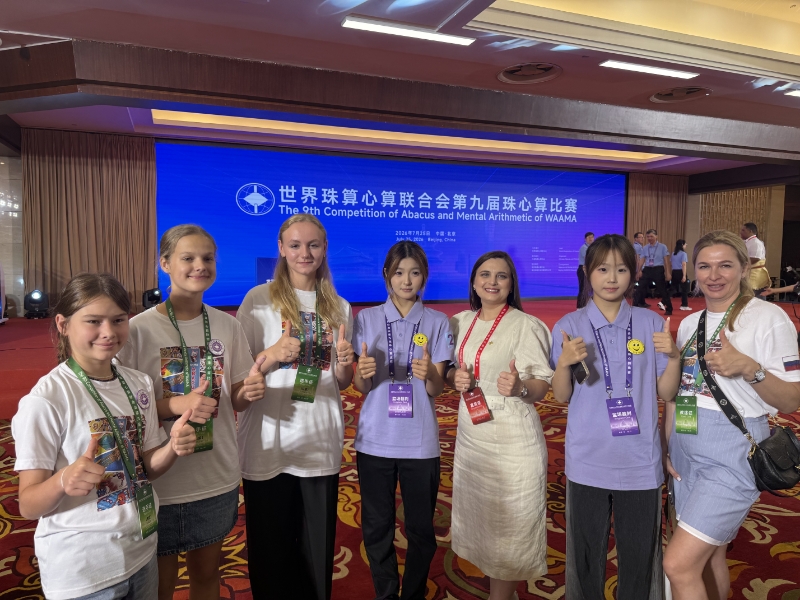
The atmosphere of the competition combined serious rivalry with genuine respect among the participants. Teachers competed alongside children, which gave the event a particularly meaningful dimension. For teachers, participation in such competitions is also an important form of professional development. It provides an opportunity to discuss and compare training methods used by colleagues from different countries, the level and complexity of competition tasks, and the requirements for speed, accuracy, concentration, and psychological resilience.
This experience can later be transferred directly to students. A teacher who participates personally in a competition becomes, in the eyes of their students, not simply an instructor or mentor, but someone who understands competitive pressure through personal experience and who is part of the professional abacus and mental arithmetic community. This experience reminded me once again that a teacher should not only teach and assess others, but should also remain an active practitioner — someone who continues to learn, challenge themselves, and develop together with their students.
It is especially rewarding to observe young participants during the competition. Each of them puts tremendous effort into achieving their goal, completing a large number of tasks of varying difficulty within a very limited period of time.
Experiencing the competition as a participant alongside the children was a source of great pride for me — both personally and as a teacher. Personal participation helps a teacher understand much more deeply the nervousness before the start, the concentration required during each task, and the significance of even a single mistake. This understanding has a direct impact on the quality of future teaching.
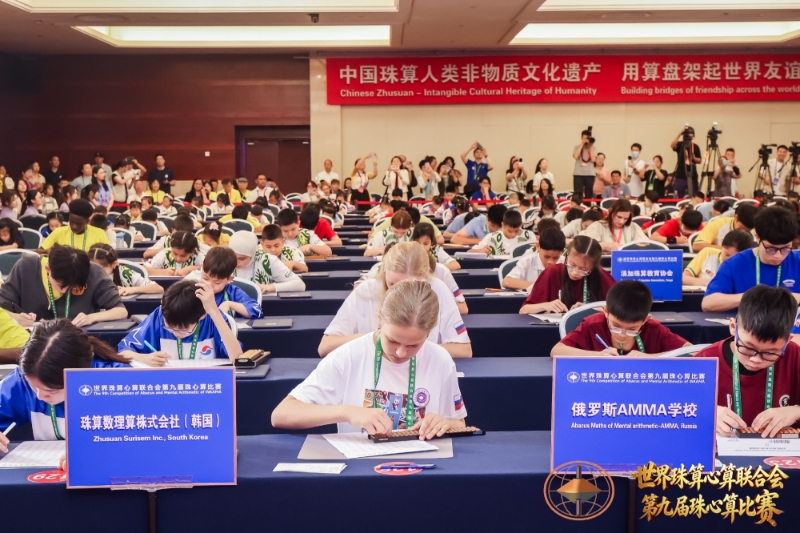
My experience during the competition:
"During the competition, my seat was located close to the centre of the competition area, between participants from Malaysia and Uzbekistan. From this position, I was able to observe many of the participants and their work.
The participant from Malaysia sitting next to me became noticeably nervous when I took my seat beside him. He apparently thought that I might be a strong competitor. What he did not know was that I was hardly his main competitor. During the first round, he remained very tense. In the second round, however, he became curious enough to glance at my answer sheet. He quickly compared our progress and realised that he had completed more problems than I had, and a joyful smile appeared on his face.
When the volunteers began collecting the papers, he excitedly turned to a teammate, pointing in my direction as if to say, "I finished faster than her." At that moment, I felt particularly warm inside—there was something truly endearing about the pure earnestness and small sense of achievement that children have.
On the other side of me sat a boy from Uzbekistan, approximately ten or eleven years old. This was his first international competition, and he was extremely nervous. He was afraid that he might miss the signal announcing the start of a round. I helped him place his participant barcode correctly, and he asked me questions about the order of the competition rounds. While completing the arithmetic tasks, he quietly pronounced every number and operation aloud in his native language. Listening to him, it almost sounded as though he were singing the calculations.
Throughout the competition, I saw children celebrating, worrying, concentrating, and overcoming their nervousness. Yet each of them was doing everything possible to achieve the goal they had set for themselves."
For children, the international competition of the WAAMA is much more than a collection of tasks and a final ranking. It is an experience of independent work, concentration, responsibility, and the ability to perform in an unfamiliar environment. It is especially important that children meet peers from other countries. Through this experience, they begin to see the abacus not merely as something they practise within their own school, but as part of a much larger international intellectual movement.
The abacus has a history spanning many centuries, but cultural heritage remains alive only when it is passed on to new generations and continues to be used in practice.
International competitions contribute to preserving these traditions and transmitting them to younger generations. When a modern child discovers the abacus, holds it in their hands, learns its techniques, participates in competitions and, most importantly, understands its history, the tradition continues to live. In this sense, the WAAMA's abacus and mental arithmetic competition also contributes to preserving the heritage and culture of calculation, passing it from today's participants to future generations. For this reason, I believe we can increasingly regard the abacus not only as cultural heritage, but also as part of a shared international educational heritage.
The 9th abacus and mental arithmetic competition organised by the WAAMA became a platform bringing together people of different nationalities and backgrounds. Participants arrived with different levels of preparation, while teachers used different methods and pedagogical approaches when preparing their students for the competition. Yet the system itself creates a common intellectual language.
An international competition can therefore become a bridge between cultures, generations, and educational traditions. Competitions of this kind create a shared professional and educational space for children, teachers, schools, and researchers.
Another distinctive feature of the competition was the use of modern technology during the fourth and fifth rounds. Participants completed tasks using a special competition application on tablets. Two types of tasks were presented — Flash and Marathon. The strongest participants of different ages, beginning from six years old, were selected to take part in these final two rounds. Within a limited period of time, they were required to complete a large number of problems. The problems were not displayed in full at once: numbers either moved upward on the screen or appeared as rapid flashes.
This created an entirely different kind of challenge. Participants needed exceptional concentration, sustained attention, well-developed reaction speed, and highly practised mental calculation skills. The faster a child entered an answer, the more time remained available for subsequent tasks.
In this way, mental arithmetic reaches another level, demonstrating the remarkable speed with which the human brain is capable of processing information and making decisions. Modern technologies can help students practise and refine their mental calculation skills. They can also analyse student performance and provide useful information to teachers.
At the same time, the unique value of the abacus lies in something that no digital system can create on behalf of a child: the process of developing an internal mental skill. It is through the physical movement of the fingers across the beads, combined with concentration, repetition, and discipline, that mental calculation skills are gradually formed. Digital technologies can then support and enhance these abilities. Technology should support tradition rather than replace the thinking processes that lie at its foundation.
The future development of the abacus and mental arithmetic will depend on how successfully we are able to combine tradition, pedagogy, international cooperation, and modern technology. At the centre of this entire system, however, must always remain the child. The purpose should not be competition merely for the sake of a medal, speed merely for the sake of a record, or tradition merely for the sake of preserving tradition itself. The fundamental purpose of an competition should be the development of the individual through intellectual practice.
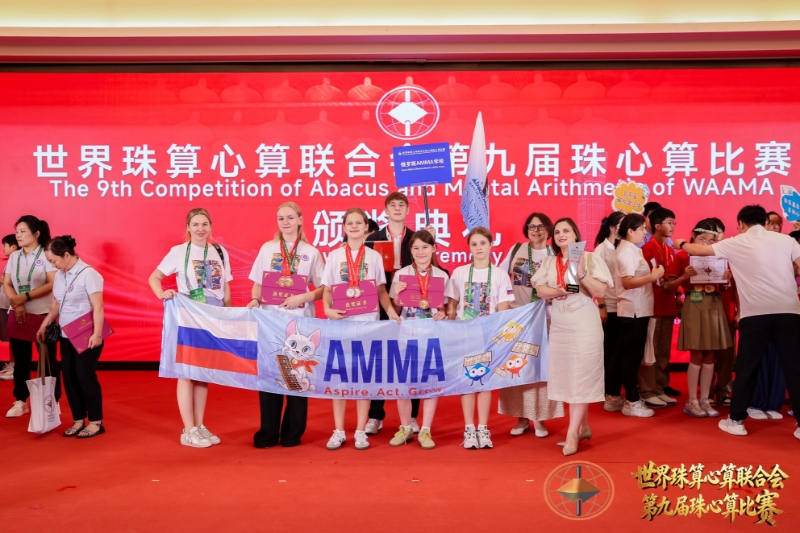
This is the perspective I brought away from the 9th abacus and mental arithmetic competition held in Beijing on July 25, 2026, and organised by the WAAMA. I hope that this perspective is shared by other participants and that it can help unite us around a common goal: not simply teaching children to calculate quickly, but passing on to them an intellectual heritage that can continue from one generation to another while helping them succeed in the modern world.
International competitions demonstrate that the abacus has the power to connect the past and the future, culture and technology, children and educators from different countries.
By preserving the past, we create the future!
Author: Elena Shumeiko, AbacusMaths of Mental Arithmetic – AMMA, Russia